React DevTools is available as a built-in extension for Chrome and Firefox browsers. This package enables you to debug a React app elsewhere (e.g. a mobile browser, an embedded webview, Safari, inside an iframe).
You can open the [in-app developer menu](https://reactnative.dev/docs/debugging#accessing-the-in-app-developer-menu) and choose "Show Inspector". It will bring up an overlay that lets you tap on any UI element and see information about it:
However, when `react-devtools` is running, Inspector will enter a special collapsed mode, and instead use the DevTools as primary UI. In this mode, clicking on something in the simulator will bring up the relevant components in the DevTools:
Make sure that the dropdown in the top left corner of the Chrome console says `debuggerWorker.js`. **This step is essential.**
Then select a React component in React DevTools. There is a search box at the top that helps you find one by name. As soon as you select it, it will be available as `$r` in the Chrome console, letting you inspect its props, state, and instance properties.
The standalone shell can also be useful with React DOM (e.g. to debug apps in Safari or inside of an iframe).
Run `react-devtools` from the terminal to launch the standalone DevTools app:
```sh
react-devtools
```
Add `<script src="http://localhost:8097"></script>` as the very first `<script>` tag in the `<head>` of your page when developing:
```html
<!doctype html>
<html lang="en">
<head>
<script src="http://localhost:8097"></script>
```
This will ensure the developer tools are connected. **Don’t forget to remove it before deploying to production!**
>If you install `react-devtools` as a project dependency, you may also replace the `<script>` suggested above with a JavaScript import (`import 'react-devtools'`). It is important that this import comes before any other imports in your app (especially before `react-dom`). Make sure to remove the import before deploying to production, as it carries a large DevTools client with it. If you use Webpack and have control over its configuration, you could alternatively add `'react-devtools'` as the first item in the `entry` array of the development-only configuration, and then you wouldn’t need to deal either with `<script>` tags or `import` statements.
## Advanced
By default DevTools listen to port `8097` on `localhost`. If you need to customize host, port, or other settings, see the `react-devtools-core` package instead.
**If you are running your app from a local `file://` URL**, don't forget to check "Allow access to file URLs" on the Chrome Extensions settings page. You can find it by opening Settings > Extensions:
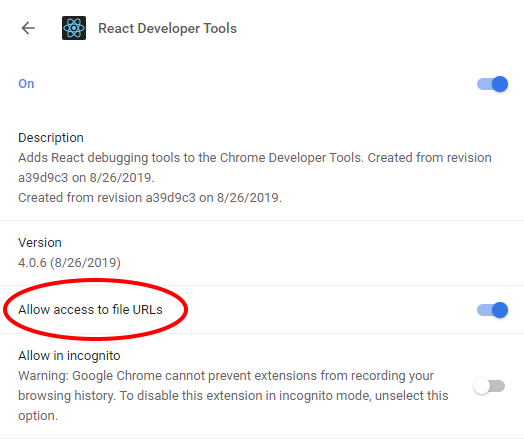
Or you could develop with a local HTTP server [like `serve`](https://www.npmjs.com/package/serve).
**The React tab won't show up if the site doesn't use React**, or if React can't communicate with the devtools. When the page loads, the devtools sets a global named `__REACT_DEVTOOLS_GLOBAL_HOOK__`, then React communicates with that hook during initialization. You can test this on the [React website](https://reactjs.org/) or by inspecting [Facebook](https://www.facebook.com/).
**If your app is inside of CodePen**, make sure you are registered. Then press Fork (if it's not your pen), and then choose Change View > Debug. The Debug view is inspectable with DevTools because it doesn't use an iframe.
**If your app is inside an iframe, a Chrome extension, React Native, or in another unusual environment**, try [the standalone version instead](https://github.com/facebook/react/tree/main/packages/react-devtools). Chrome apps are currently not inspectable.
**If you still have issues** please [report them](https://github.com/facebook/react/issues/new?labels=Component:%20Developer%20Tools). Don't forget to specify your OS, browser version, extension version, and the exact instructions to reproduce the issue with a screenshot.
The standalone DevTools app can be built and tested from source following the instructions below.
### Prerequisite steps
DevTools depends on local versions of several NPM packages<sup>1</sup> also in this workspace. You'll need to either build or download those packages first.
<sup>1</sup> Note that at this time, an _experimental_ build is required because DevTools depends on the `createRoot` API.
#### Build from source
To build dependencies from source, run the following command from the root of the repository:
```sh
yarn build-for-devtools
```
#### Download from CI
To use the latest build from CI, run the following command from the root of the repository:
